Jury-riggers and goldplaters
In maritime transport and sailing, jury-rigging involves making temporary makeshift running repairs with only the tools and materials on board.
...
Goldplating is a method of depositing a thin layer of gold onto the surface of another metal, most often copper or silver.
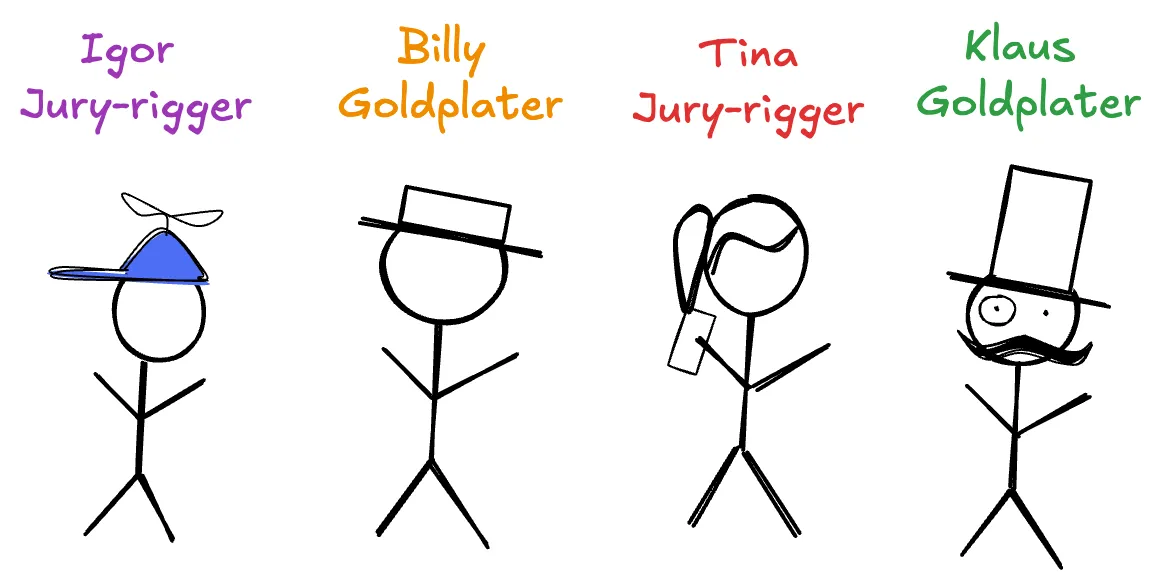
The best teams have a diverse set of skills and attitudes, but what's the ideal composition? Igor, Billy, Klaus and Tina are a group of product builders that ship cool and useful things together at Acme Inc.
Igor and Tina are jury-riggers1 who are resource conscious and try to build solutions that maximize impact with the least amount of work. Their favorite phrase is you aren't going to need it. Billy and Klaus are goldplaters who like to think about the future, and favor solutions that cover edge cases and what we might need 6 months from now. Their favorite phrase is what if?.
The two pairs were each on their own team. It made sense considering how well they got along. Igor and Tina blazed through their projects, delivering their work always as estimated. Billy and Klaus were also in their element - mapping out systems, scoping carefully, and pressure-testing every assumption before writing a line of code. They were laying the groundwork that would make the next five features easier in addition to what they needed to do today. Their designs anticipated the edge cases, and their abstractions promised to leave the codebase cleaner than they found it.
But over time, the pairings showed their cracks. Igor and Tina, in their rush to ship, cut corners that turned out to matter. For Billy and Klaus, every scenario felt worth planning for, and they spent as much time planning as they did building. Sentiment in Acme Inc. was that they were polishing foundations for a building that hadn't gone up yet.
Desperate for change, Acme Inc. combined the two teams. While they were concerned that polar personalities would clash, they needed to try something. There was a period of forming, storming and norming before performing finally came, and better than expected. With the jury-riggers and goldplaters keeping each other in check, the goldplaters did not go overboard with their implementations. The jury-riggers still worked at pace, but were reined in whenever their solutions introduced too much risk, or carried too many trade-offs.
The merged team started shipping features faster than either half had managed alone, with far fewer fires to put out along the way. Customers noticed the newfound reliability, and leadership pointed to the team as a model for how the rest of Acme Inc. should work. In the end, Acme Inc. IPO’d to great acclaim with 10x returns. Igor, Billy, Klaus and Tina lived happily ever after.
Beyond the parable
Credit to my brilliant colleague Nicolaj for introducing me to these two terms which brought me a lot of joy. We have different positions on the jury-rigger/goldplater axis, and our passionate discussions help us build the best possible thing for our customers.
This parable is, of course, a caricature. People are multifaceted and can have characteristics from both ends of the spectrum. The goal is to strike the right balance and understand when it’s appropriate to be more jury-rigged than goldplater and vice versa. This is easier said than done and a much longer story for another day.
Further reading:
The just-say-no engineer was a ZIRP phenomenon
Not to be confused with jerryrigging, which implies crudeness↩