The software industry needs more Brunels
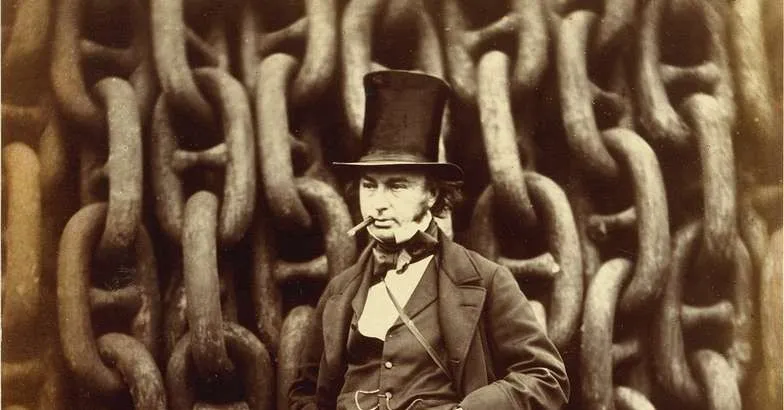
“Of all the wonderful feats I have performed, since I have been in this part of the world, I think yesterday I performed the most wonderful. I produced unanimity among 15 men who were all quarrelling about that most ticklish subject - taste.”
— Brunel on getting approval for his design of the 700ft Clifton Suspension Bridge, the longest of its time
Brunel would have made an excellent product manager, whose job is often about getting different people to agree on a contentious thing.
Growing up, my dad would always praise a man called Isambard Kingdom Brunel, a 19th century civil and marine engineer (amongst other things). It wouldn't be possible to go on the Great Western Railway's (GWR) London to Bristol line without hearing about how Brunel built the Box Tunnel.
Well, after three decades of nodding along to “did you know Brunel built that…?”, I finally read about the man for myself and was delighted. The scale of work Brunel delivered in his short life is an inspiration.
Brunel built hundreds of miles of rail for the GWR, dozens of bridges, some of the largest ships of his time, and landmark buildings such as London Paddington and Bristol Temple Meads stations. This was all done over a thirty-year period starting from the early 19th century.
So why is Brunel, someone who worked in the engineering domain in a bygone time fascinating to me, a product manager today who spends 8+ hours a day in front of a screen moving pixels and typing on a keyboard?
It's because his success with a hands-on, interdisciplinary approach in the much risker domain of 19th century construction is an inspiration to software builders today who could feel inhibited by any perceived shortcoming: whether it's their lack of formal education in their software domain of interest, or the box that their title puts them in, or anything else that we as humans are very good at coming up with to discourage us from doing something extraordinary. The limit is only the extent of your passion and interest and Brunel is a model in that regard.
“I must observe that no man can be more sensible than I am of the great advantage it would be to me as a civil engineer to be better acquainted with geology, as well as with many other branches of science.”
Brunel in his journal - June 1842
The quote above also applies to building good software: a product manager can greatly benefit from learning in computer science, design and business domains. The same thinking applies to any other role. Once you are capable enough in your specialization, there is a great return on time spent learning any of the other many disciplines that are required to build and sell great software.
Learnings from Brunel’s history reinforces that:
- We can be more hands-on than we think regardless of the level we work at and there is great value in doing so
- We should not let our job description restrict our scope to make impactful change
- We should operate with a constant sense of urgency. Momentum is king.
Brunel simultaneously managed to be in the details, from surveying land by horse for the next set of tracks to be laid, to challenging contractors on the quality of brick being used for the smallest bridge, to even picking the fabric that would be on the seats of the GWR carriages (I doubt it is the same fabric today, but my wife remarks that she’s not a fan).
Here is a quote on how Brunel saw his role in any given project:
“The term ‘Consulting Engineer’ is a very vague one, and in practice has been too much used to mean a man who for a consideration sells his name, but nothing more. Now I never connect myself with an engineering work except as the Directing Engineer who, under the Directors, has the sole responsibility and control of the engineering, and is therefore ‘The Engineer’; and I have always objected to the term ‘Consulting Engineer’.”
Brunel on being appointed to the Australian Steam Navigation Company in 1851
And an example on the pace and quality at which Brunel delivered work:
During the Crimean War (1853-1856), Brunel was tasked by the War Office to design and construct a hospital to reduce the drastic British casualties due to disease from poor hospital conditions. From the initial tasking to the actual delivery of Renkioi Hospital, it took Brunel less than 6 months, and it was a massive success, reducing the fatality rate of the wounded by tenfold from ~40% to 4%.
If Brunel was able to work at pace and across disciplines in the 19th century while building bridges, railways and tunnels where the risk of failure is so much higher - and taught himself whatever each domain demanded, what is stopping us from doing the same in the more malleable software industry, which is much more forgiving to experimentation?
“Any part I have taken in examining into the system has been purely from the desire which I always feel to forward good inventions.”
If you’d like to read more about Brunel, I recommend starting with Steven Brindle’s Brunel: The Man Who Built the World
If, like me, you wonder where the name Isambard came from, you can read this article